Government's End by Jon Rauch
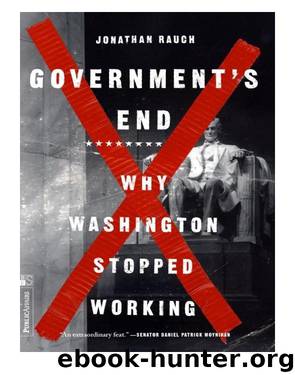
Author:Jon Rauch
Language: eng
Format: epub
Publisher: PublicAffairs
Published: 2011-02-28T05:00:00+00:00
A Stricken Giant
As the disease of demosclerosis advances, it causes a paradoxical and pathetic symptom: bogus national poverty. In Washington, it became the conventional wisdom in the 1980s and 1990s that programs and ambitions that were once affordable had become “too expensive.” For a time, penury seemed a result of the fiscal pressure from chronic budget deficits, but after the deficit melted away the budget remained as tight as ever. The deficit, apparently, was not the sole problem. In the 1940s, America could “afford” the Marshall Plan to set Europe back on its feet; in the 1990s, America could not “afford” any remotely comparable effort to help the former Communist countries find political and economic stability. In the 1960s, America could “afford” a program to send astronauts to the moon; in the 1990s, America struggled mightily to “afford” even a modest orbiting space station. Subjectively, in the world of feelings, the government was poor, or in any case much poorer than in the fat years of Kennedy and Johnson. But objectively, in the world of fact, this was absurd.
The United States is now wealthier than any other country in human history, including its prior self. Per capita disposable income, adjusted for inflation, is more than twice as high as in 1960, when the federal government could “afford” almost anything. Real wealth per capita is at least 75 percent higher than in 1960, and real economic output per capita has more than doubled. To speak of the American economy as though it were “poor” or unable to buy what was once affordable is, by this standard, preposterous.
Likewise, the federal government is not poor, either in absolute terms or relative to its postwar heyday. The government’s income, after adjusting for inflation, is more than three times its income in John F. Kennedy’s day; government spending, also adjusted for inflation, is more than four times higher than in 1945, the peak of the mighty mobilization for World War II. The notion that taxes have been slashed to unusually low levels is simply wrong: Measured as a share of the economy, the government’s receipts in the 1980s and 1990s were well in line with the postwar norm and slightly above the level of the “wealthy” 1950s and 1960s. In objective terms, the federal government is better able today to “afford” initiatives than ever before in history.
So here is another paradox: As the nation grew objectively richer, it felt subjectively poorer. Why? If government is “poor,” if it is unable to “afford” things, that is because of its inability to unlock resources from entrenched claimants and reallocate them for new needs. It is not poor; it is paralyzed. It is not malnourished; it is maladaptive. It is trapped in its own past, held there like Gulliver in Lilliput by a thousand ancient commitments and ten thousand committed clients.
Download
This site does not store any files on its server. We only index and link to content provided by other sites. Please contact the content providers to delete copyright contents if any and email us, we'll remove relevant links or contents immediately.
| Anthropology | Archaeology |
| Philosophy | Politics & Government |
| Social Sciences | Sociology |
| Women's Studies |
The Secret History by Donna Tartt(19297)
The Social Justice Warrior Handbook by Lisa De Pasquale(12224)
Thirteen Reasons Why by Jay Asher(8998)
This Is How You Lose Her by Junot Diaz(6955)
Weapons of Math Destruction by Cathy O'Neil(6363)
Zero to One by Peter Thiel(5867)
Beartown by Fredrik Backman(5839)
The Myth of the Strong Leader by Archie Brown(5552)
The Fire Next Time by James Baldwin(5503)
How Democracies Die by Steven Levitsky & Daniel Ziblatt(5271)
Promise Me, Dad by Joe Biden(5189)
Stone's Rules by Roger Stone(5130)
A Higher Loyalty: Truth, Lies, and Leadership by James Comey(5017)
100 Deadly Skills by Clint Emerson(4972)
Rise and Kill First by Ronen Bergman(4838)
Secrecy World by Jake Bernstein(4798)
The David Icke Guide to the Global Conspiracy (and how to end it) by David Icke(4771)
The Farm by Tom Rob Smith(4550)
The Doomsday Machine by Daniel Ellsberg(4548)
